Saturday, 26 April 2014

The Pilgrims leave for America.

A snippet from ONE SMALL CANDLE as the Pilgrims leave Holland on the Speedwell for England on the first leg of their journey to America:

John Robinson came over and sat down on the blanket beside Will, linking his hands over his drawn up knees. ‘I would that I could come with you Will,’ he said.
‘We will miss you,’ Will told him. He paused for his heart was full of love for this fearless proclaimer of God’s Word, yet not knowing quite how to express it. ‘I will miss you.’ It was no more than the truth. ‘I want you to know, Brother, that you, and Brother Brewster, have been like fathers to me. I have learned so much from you both.’

John Robinson smiled that quiet smile of his, and said gently: ‘We’ve watched you grow up, Will, seen you at a tender age take a stand for the Truth. Don’t ever compromise the Truth. Stand upright for the Lord. Be strong, Will. The company rely on your good sense and your capableness. You are an elder and you know what you are about. Work together with Master Brewster, and Master Carver and Master Fuller. You have strength in you. Use it.’

Will was silent, feeling that he was unworthy of this great man’s accolade, yet deeply grateful for it at the same time.

John Robinson put his hand inside his jerkin and brought out some sheets of paper folded up together and sealed. ‘I have written a letter for all the brothers and sisters, and all those going along with you, which I hope will encourage you all.’

Will took the letter and John put his hand on his to stop him opening it. ‘No, it is for when you sail from Southampton. Give it into the hand of Brother Brewster when you meet him there.’

Obediently Will tucked it into his doublet. ‘Yes, I will.’

‘And write to me, Will. Tell me the details Brother Brewster will not think to tell me, for he is lazy when it comes to writing letters, I think. Look how few he has sent since he has been in England!’

‘I will write,’ Will promised.

John sighed, and the silence between them was awkward. ‘I would I were going with you,’ he repeated. ‘You have no idea how much this means to me, how much I long to go. You are doing the Lord’s work in this. Build a settlement, a colony, help others to come after you, to a place where a man may think and worship as he wishes. And one day, perhaps I can come to you, if the Lord wills it.’

‘I would you were coming now,’ Will told him.

John’s eyes took on a glow as he saw America in his imagination. ‘This will be our Promised Land, Will. We will build Jerusalem, a cause for rejoicing, in the wilderness. A land built on the free worship of God. You are young, Will. You will bear the burdens well. And God will go with you.’

As the dawn approached on Saturday 22 July 1620 they began to board the Speedwell. The warm night had turned to rain, soaking passengers and crew and well-wishers.

To Captain Reynolds’ intense annoyance, everyone went aboard, including those saying farewell. The ship’s decks were a tangle of people, men and women and children, getting caught up in the ropes, in the way of the sailors.

The moment had come. They wept in each others’ arms, and sobbed, and prayed together. Children wept at being parted from parents. Fear and Patience Brewster sobbed in their mother’s arms, for she was going and taking her two young sons with her and they were not. Bridget Fuller clung to her husband Sam as he tried to comfort her. Digorie Priest said goodbye to his wife Sarah and his sons who were staying, and Sarah Priest in her turn hugged her own brother Isaac Allerton and his wife Mary and their three young children for they were all going. Nothing, Mary Allerton had declared to her husband when he suggested she and the little ones should stay at home, would prevent her from taking her place at her husband’s side, and where she went, her children went, as a matter of course. William White, who was going with his very pregnant wife, Susanna, Sam Fuller’s sister, and their sole surviving son Resolved, aged just five, bid farewell to his cousins Roger White and Bridget Robinson. Mary Cushman was a passenger, ready to meet her husband in Southampton. Catherine Carver kissed her sisters Bridget Robinson and Jane Thickens and Frances Jessop, and her brothers Thomas and Roger White. She was also to meet her husband John Carver in Southampton. Edward Winslow and his wife Elizabeth who had become beloved by all the congregation, had no-one to say goodbye to, but the Blossoms, Thomas and Thomas junior who were going wept with Anne, wife and mother to be left behind.

John Robinson fell to his knees on the deck, and, as if it were a signal, the noise suddenly stopped, and with almost one motion everyone of the congregation fell to their knees with him. In prayer, with tears, John Robinson begged God for his love and help towards the travellers—the Pilgrims.

Now the time had come for Will and Dorothy to part from her parents and her sister, and their five-year old son Jonathan.

The parting  was worse than Will had anticipated. An agony that would stay with him a lifetime. For all his youth Jonathan understood that his parents were leaving him, perhaps forever. He clung to Dorothy, sobbing and begging her not to go.

Dorothy sobbed as she held him tightly. ‘There, there, don’t cry my little man. We’ll soon see you again. I promise.’ But her efforts at soothing him were hampered by her own sobs.

‘Mother! Please don’t go! Don’t leave me here! Please. I want to go too.’

Will bent down and tried a sterner tactic. ‘Now John, no more of this crying. You must be a man and look after grandmother.’

But Jonathan clung all the harder and wailed pitifully.

Will took him from Dorothy, and held him in his own arms. This was his son, his own flesh and blood. Will loved him as a father must, and his resolve weakened. But he was not ignorant of the dangers that lay ahead. No, Jonathan was far too precious to risk on a venture that he knew was fraught with danger.

Deprived of Jonathan, Dorothy threw her arms around her mother and the two women wept, and then her father, as Will gave Jonathan into his grandmother’s arms. With promises to write and to the sound of Jonathan’s hysterics, Will gently pulled her away, allowing them to leave the ship.

Captain Reynolds’s voice could be heard above the tumult. They must make sail or lose the tide.

With all those ashore who were going ashore, Captain Reynolds gave his orders to the mate: ‘Make all sail!’

‘Lay aloft there, you laggards!’ cried the mate, and barefooted sailors ran up the rigging, loosing the sails. Others cast off and the ship began to move.

The passengers lined the gunwales as the wind filled the sails and the Speedwell moved away from the quay, slowly at first, then with growing speed, out into deep water. The passengers waved to their friends and families, calling out last-minute messages.

And there in the front of the bystanders, his blonde curls shining like ripe corn was Jonathan, Will’s last sight of him, standing between his grandparents, crying out for his mother, little hand outstretched to the ship.
Will watched him until they were out of sight, as tears streamed down his own face.

ONE SMALL CANDLE Available in print and Kindle editions
Click link below:
USA  
AUSTRALIA Kindle only.
For other countries please see Amazon

Also available in Print and Kindle formats from Amazon.


Tuesday, 8 April 2014

MEET THE HERO OF MY NEW NOVEL

This is my contribution to the chain of posts by historical fiction authors in which we introduce the main character of our work in progress of soon-to-be-published novel.

1.  What is the name of your character? Is he fictional or a historic person?

Roger L’Estrange is a real historical person who was born in 1616.

2.  When and where is the story set?

1640 to 1648 which is during the English Civil War. The story is set in Norfolk, particularly in Hunstanton and in King’s Lynn.

3.  What should we know about him?

Roger L’Estrange is the third and youngest son of Sir Hamon L’Estrange. He is an impetuous young man, a dashing cavalier, eager to fight for the King.

4.  What is the main conflict? What messes up his life?

His royalist father seizes control of King’s Lynn from the hands of Parliament, which brings Oliver Cromwell and Lord Manchester and a large army to the town to lay siege to it. Both Roger and his brother fight to defend Lynn. At the same time Roger falls in love with a beautiful Puritan woman, which earns him the displeasure of his father.

5.  What is the personal goal of the character?

Roger wants to win the approval of his father and his King. At the same time he is fighting to win his lady despite the disapproval of both their families. Furthermore he wants King’s Lynn in the hands of the royalists, and he will do anything to achieve it.

6.  Is there a working title for this novel, and can we read more about it?

It is called For The King, and subtitled Roger L’Estrange and the siege of King’s Lynn during the English Civil War (might change that last bit!).

7.  When can we expect the book to be published?

Well I was hoping for the spring, but as the spring is already in full swing, I think it might be a bit later! It is taking longer than I thought. At the latest in the autumn, but possibly in the summer. Either way, not long!

You can read a snippet from FOR THE KING at http://evelyntidmanwrites.blogspot.co.uk/2014/04/for-king.html

I have tagged other authors who will be posting about their main character on the 12th April:  


Beth Von Staats 


My other books available from Amazon:


FOR THE KING


The Battle of Newburn

Newburn, near Newcastle-upon-Tyne, August 1640

As Roger Le Strange watched the sea of blue hats of the ranked masses of Scottish Covenanters across the Tyne valley his heart shuddered in his chest. They outnumbered the King’s army and were better prepared, more experienced.
‘’Sblood, we’ll be slaughtered!’ someone along the line swore and Roger glanced towards him. No-one smiled. They sat on their restless horses grim-faced, staring at imminent death, mechanically struggling to keep them in the rank.
Roger’s gloved hand shook as it held the rein. No wonder his horse sidestepped.
‘You know what Leslie intends to do, don’t you?’ His father’s deep voice beside him caused him to turn his head sharply to look at him. As ever, Sir Hamon was cool, matter-of-fact even. His grey eyes briefly held the ghost of a smile and he calmed Roger.
He took a steadying breath. ‘He wants to take Newcastle.’ The Scottish target, the town of Newcastle, with its fortifications was no more than five miles to the east but here at Newburn with its ford was the crossing point over the Tyne.
‘Indeed.’ Sir Hamon squinted in the bright August sun at the opposite bank. ‘They’ve got artillery in the tower.’
Roger’s eyes followed his gaze to the top of the square church tower where shadowy dots moved about behind the battlements. He could not see the guns, but he knew they were there ready to rain death on the King’s men. ‘I see them,’ he said. ‘How in the name of all that is sacred did they get them up there?’
‘A lot of heave-ho-ing I shouldn’t wonder!’ Sir Hamon turned his attention to the King’s army, the infantry, the pikemen, the gunners massed on the slopes below them. ‘Damn shambles!’ he grumbled. He referred to the troops Viscount Conway had mustered for the king, a ramshackle army of raw and largely untrained recruits, ordinary men who had marched from the south of the country to arrive exhausted and demoralised  in the borderlands. Many of them had no heart for the fight. They were there because of loyalty to their ‘lords of the manor’ who had been summoned to the King’s army. An undisciplined and unwilling rabble, Roger thought. They had no idea of the cause of the argument, no grasp of the politics, no pay and no reason to fight.
Sweat trickled down Roger’s back and stood out on his clean-shaven lip. He wore a thick, padded gambeson beneath his coat so that the armour did not chafe through to his skin.
They had lapsed into silence, father and son. Tension swaddled the waiting troops. Beyond their own artillery the grassy bank shimmered in the heat. On the opposite bank the Scots lined up their men behind the guns. On the King’s side too, men were lined up in ranks. They moved around as though they were out for a Sunday stroll, shuffling in the heat, weighed down with glinting armour, those that had it, forming into ragged lines, while the officers rode up and down bellowing orders. The King should have had a retained army, trained, ready. But with Parliament withholding payment, he simply could not afford it. As it was, he could not pay the troops now. The lords had to see to it.
‘What’s this?’ Sir Hamon moved away a little and stood up in the stirrups to get a better look. Roger followed his example. A rider, no three riders, came out from the Scottish ranks, splashing across the river Tyne at the Newburn Ford and galloped into the English camp.
Sir Hamon immediately dismounted, handing the reins to his son and marched to Viscount Conway’s tent. As a mere younger son, Roger was not privy to the conversations of his commanders, whereas Sir Hamon was. But as Lord Conway emerged from his tent to meet the riders, he jumped down from his horse, handed the reins of both horses to their groom who had magically appeared from behind him and followed at a run behind his father and found himself at the rear of Lord Conway’s men. He was considered a tall man, but their hats obscured his vision, so that he moved more to the side to see what was happening.
The messengers dressed in tartan skirts and sashes and blue coats did not dismount, but one of them sporting an impressive red beard walked his fine chestnut mare forward. Even then he stayed mounted, staring haughtily down on the English Lord. The Scottish heathens lacked common manners!
‘General Leslie sends his compliments to Lord Conway,’ he bellowed in a thick lilting Scottish brogue so that Roger had to concentrate hard in order to understand him.
Viscount Conway, an elegant man, with long flowing light brown hair and an immaculate moustache and small beard, graciously inclined his head in stark contrast to the uncouth Scottish messenger who continued:
‘We, the Covenanters do not wish to fight the English but General Leslie requests free passage so that we may petition the King.’ He leaned forward and held out a scroll of paper so that Lord Conway could reach it.
Breaking the seal, Lord Conway took a minute to read while the messengers waited and everyone else held their breath.
Then he pursed his lips. ‘Tell the General that I cannot accede to his wishes,’ he said and turned his back on the messenger to return to his tent, contemptuously dismissing him.
The Scotsman’s eyes flashed in anger and all of Conway’s men reached for the swords on their hips, but although the man grumbled something incomprehensible he turned his horse’s head and spurred the animal into a gallop down the slope towards the Tyne, his companions following behind.
Conway stopped at the tent entrance and turned to Colonel Lunsford in command of the artillery. ‘Make ready the guns.’
Sir Hamon left Conway’s men and Roger joined him as they returned to the cavalry. Sir Hamon shot him a censuring look, but chose not to mention Roger’s impertinence. The drummers began to beat the advance and Roger felt that swoop in his belly of fear and excitement.
‘This is it,’ Sir Hamon said to Roger. ‘Remember what I taught you. No heroics. Do not risk your life. Make your sword thrusts true.’
He walked quickly, but Roger kept pace. ‘I will watch your back, sir.’
He stopped and looked at his son, tenderness in his eyes. ‘If I do not come home, look after your lady mother,’ he said.
Roger nodded and swallowed.
Shouts behind them warned them as the first cannon fired. Turning around, Roger’s heart swooped as he saw the Scottish cavalry advancing towards the ford. A plume of spray in the Tyne showed where a cannonball from the Royalist’s side hit the water, the aim too short, but the English adjusted their aim and continued to fire on the Cavalry with the boom of cannon, spewing smoke and the shuddering of the hot August air. The smell of burning gunpowder wafted towards them and all at once Roger and Sir Hamon ran for their horses.
Scottish horses collapsed beneath their riders, mown down by the barrage of fire from the Royalists, then the Scots retreated. However the small victory was short lived. From their vantage points on the slightly higher ground, the Scots retaliated by pounding the English guns.
By now Roger and Sir Hamon had reached their positions and took possession of their mounts, Roger leaping into the saddle, Sir Hamon hopping up stiffly from the stirrup.
The bombardment was relentless and the gunners turned and fled. ‘Look at them!’ Roger cried in disgust. ‘They run from the Scots!’
Frowning at the retreating figures of English artillery running from the enemy, Sir Hamon merely said: ‘Raw recruits. Even Colonel Lunsford cannot keep them.’ From this higher point they could see the Scots pouring across the dark river at the ford, could see the whole battle being played out beneath them.
Frustration made Roger grind his teeth. ‘We need to give fire!’ But there was no-one left to give fire, they had fled.
‘Here they come!’
The cry from along the ranks made Roger draw breath. Beneath him his horse fidgeted and nodded his head. With an effort Roger held him, patted and stroked the animal’s neck with a black gloved hand and spoke to him in low tones, but his eyes were on the oncoming Scottish hordes.
‘Hold you hard there, boy.’ Sir Hamon’s voice was low. Roger took a steadying breath. All along the cavalry line the king’s men drew their swords with the ring of metal, holding them upright in their hands, ready for the order.
They waited as the Scottish cavalry charged down the hill.
‘We should go,’ Sir Hamon muttered. ‘He’s leaving it too late.’
Then as the Scots crossed the river, the order came from Henry Wilmot, in command of the cavalry. ‘Charge!’
Digging his heels into his horse’s flanks, with his father at his side, Roger leaned forward in the saddle as his bay stallion sprang into action like a suddenly released spring, hurtling headlong down the grassy slope, hooves thundering over the uneven turf.. Roger kept pace with everyone else, his sword held out in front of him. No man wanted to be the one out in front when they met with the enemy, but neither did he want to be the last man.
The Scottish musketeers had already taken up their positions.
Suddenly confronted with two ranks of black muzzles, the first of the cavalry came to a sudden halt in front of Roger and his father. Quickly they pulled up on the reins as the upper rank of Scottish muskets belched smoke and popped. A whisper of hot air next to Roger’s ear, felt rather than heard, was too close for comfort.
In the confusion, men and horses were hit.
It was too much for the inexperienced English. They too broke ranks and began to retreat to get out of the murderous, death-dealing fire. Sizing up the situation, Roger grabbed the reins on Sir Hamon’s mount and pulled him round.

‘Let’s get out of here,’ he bellowed.

FOR THE KING Roger L'Estrange and the Siege of King's Lynn, an English Civil War novel will be published in the autumn.

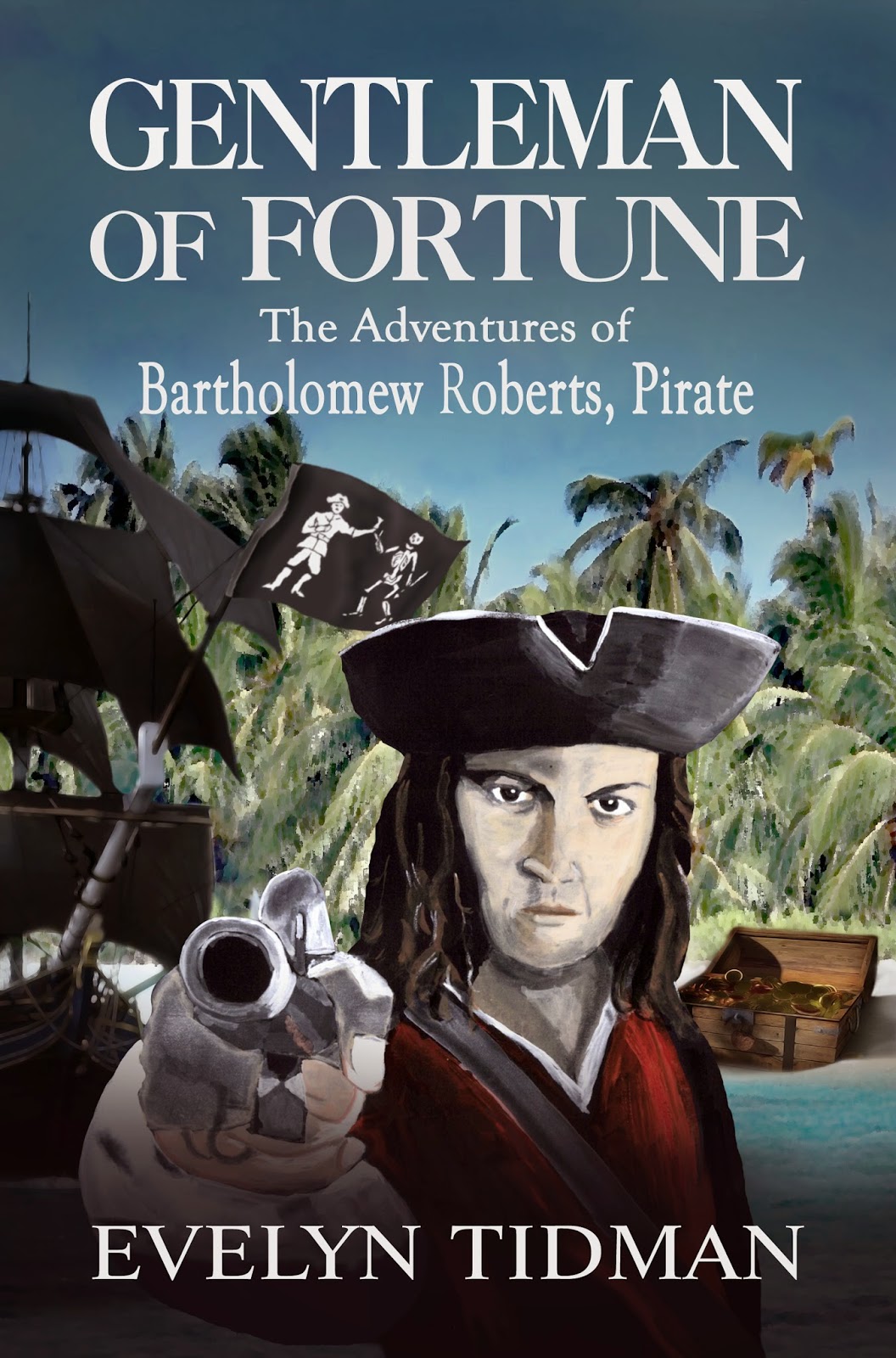
Evelyn Tidman is the author of GENTLEMAN OF FORTUNE The Adventures of Bartholomew Roberts, Pirate and ONE SMALL CANDLE The Story of William Bradford and the Pilgrim Fathers available from Amazon
www.evelyntidmanauthor.com


Sunday, 23 March 2014

FORMATTING YOUR BOOK FOR KINDLE For Those Who Are Not Whizz-kids On The Computer

With the difficulty of landing a publishing contract, many writers are going it alone on the self-publishing trail. I'm one of them. And I have to say that when I had finished the writing and needed to find a way of getting it 'out there' it was like hitting a wall. I had no idea how to get up and over it, or round it, or through it. It seemed impenetrable.

But bit by bit, I managed it, as many others have. But not without tears and tantrums a-plenty. How the computer is still in one piece I do not know!

To save others the trauma of fighting their way through this wall, I thought I would explain what I have learned.

The following applies to Amazon Kindle and is for those who are not computer buffs. That probably means the older ones among us, because the kids can all make a computer whistle 'Dixie' as it dances up the street! So this is the guide for those who don't know how to do hardly anything!

The work starts as you write your book. Already written it? Well, you'll no doubt have to make some changes.

Kindle does not recognise the tab key. So if you have used it for your paragraph indentations, each and every one of them will have to be re-done. I use Word 2003, so the instructions here are for that. No doubt other versions of Word will not be too different.

Go to the start of the word which begins the paragraph and backspace so that it is now on the margin. Go into Format > Paragraph > Indents and Spacing and on the bit which says 'Indentation' go onto 'left'. Change the figure in the box to whatever you want - I use 1.0 cm for indents. Click OK. Your paragraph will be indented. All of it. Do not panic. You have a hanging paragraph. Now click unhang. If you do not have that on your toolbar, you need to put it there. (Tools > Customise > Format and on the right hand column scroll down until you reach 'unhang'. Click and drag it to your toolbar.)

Sadly you will have to go through this palaver for all the paragraphs in your book. But if the book is not already written, doing it once for the first indented paragraph will do. You will notice that every paragraph will automatically indent when you hit the 'enter' key.

While you are in the 'paragraph' box, right at the top click 'Line and Page Breaks' and make sure everything is unchecked. You do not want 'orphans and widows' messing up your formatting, which it does; likewise 'keep lines together'. You may need to do this for every section of your document. You cannot rely on highlighting All (ctrl+A) and then doing it. If you haven't yet typed anything, do it as you indent your first paragraph.

Note: The first paragraph of a chapter or a new scene is not indented.

To remove the paragraph indent again, Format > Paragraph > Special and in the drop down box click 'none'.

A word about spacing. It's got to be single line spacing, even between paragraphs. Use double line spacing only when there is a change of scene, and you may want to put in then a few asterisks, or dashes or whatever takes your fancy. Up to you. But if that bit ends up at the bottom of a page, the reader will not be alerted to the change of scene without some indication.

Only one space between words, please. And British writers, especially those who have been taught to type and put two spaces after full-stops, question marks, exclamation marks, colons and so on, DON'T. I know it's a bind, but you have to learn not to do it. A bit of retraining needed here. The reason is that when you justify the right hand margin, the computer automatically shuffles the words along and you have these huge great gaps in the line where your extra space is. You might be able to find them all by using Find/Replace. I went through it several times using this method putting a full-stop and two spaces in the 'Find' box and a full-stop and one space in the 'Replace' box. Ditto for question marks etc. And don't forget after speech marks.

For Kindle, do not put in page numbers as the pages adjust automatically on a Kindle as the reader adjusts the font size. That is also why you do not want 'orphans and widows'.

Start each chapter on a new page. At the end of each chapter Insert > Break.

There is a way of inserting a 'Table of Contents' whereby the reader can click on a chapter heading in a list at the beginning of the book and go straight to that chapter. I haven't figured that out yet, but there are on-line tutorials for that.

When you are happy with your work, justify the RH margin. For those who do not know, the command looks like this:
Click the one on the right.

Don't forget to proof-read your book.

Don't forget to add the title page and copyright page etc.

At the point where you want the book to start, (normally at the place where it says Chapter 1) Insert > Bookmark and add the word START.

Right, now you are almost ready to go. Now you have to change your document to an HTML Filtered file. To do this, open your book file. Click 'Save As'. Now at the bottom of the box, beneath the bit which says 'File_name', there is a drop-down box which is labelled 'save as type' and beside it it will say 'Word document' in a drop-down box. Click the arrow. Click 'Web Page, Filtered', because that is what you want. (It took me three days to find this. I know, I know, but I just couldn't figure it out! Trial and error got me there in the end!) Click 'Save'. You'll get a warning about 'office specific tabs', but just click 'Yes'. You will still have your original Word document, and now you will have a new one next to it with a symbol which tells you it is your HTML Filtered file.

Now go to KDP Amazon (Kindle Direct Publishing) and if you have not already signed up etc. do it now.

As you fill in the on-line form you will upload your cover file. And when you are asked to submit your interior file on the form, it is already there on your computer and waiting for you to upload it. Go through it on the proof-reader to make sure it looks OK.

Fill in the rest of the form. Click 'Publish'. But don't panic, because you can change your file at any time - such as if you suddenly discover some glaring error! (I found to my horror that I'd left the T out of GENTLEMAN OF FORTUNE on the title page! I looked on Amazon, and there it was(n't)! I soon got that rectified.)

Have a glass of wine (or cup of coffee if you prefer) and a large slice of cake. You deserve it!


Evelyn Tidman is the author of GENTLEMAN OF FORTUNE The Adventures of Bartholomew Roberts, Pirate and ONE SMALL CANDLE The Story of William Bradford and the Pilgrim Fathers - www.evelyntidmanauthor.com


Tuesday, 28 January 2014

Does Wrongdoing In Religion Mean There Is No God?

'I don't believe in God. Religion causes all the wars in the world.'

A generalisation? Of course. Perhaps, like me, you have heard that said many times as a reason for not believing in God. Obviously, not all the wars fought in the world are because of religion. Nevertheless, many feel that because people who claim to represent God slaughter one another, or do other things which they know to be wrong, that there cannot be a God. If there is a God, they reason, then his people would not be doing these things.

They are right to a point. HIS people would not be doing these things. But it doesn't mean that God does not exist. Why?

Everyone who has connection with Christianity in any form knows that Jesus said 'You must love your neighbour as yourself,' and he gave the story of the Good Samaritan to prove the point. Love of neighbour is fundamental to Christianity, just as much as love for God. Love for one's neighbour does not allow a person to kill someone else, or even to hurt them, except in self-defence, or in defence of one's family. Yet the two most murderous wars in history broke out in countries which are predominantly Christian. The first and second world wars had Christians on each side killing each other. Catholics killed Catholics, Protestants killed Protestants. The various churches in each land involved preached that it was one's duty to kill those on the other side.

But, a person may ask, what would happen if people refused to defend their country because they were Christian?

The simple answer is that if all Christians on both sides had refused to fight, there would have been no war.

A friend of mine, now dead, had been a nineteen-year-old in command of a tank division in France during the second world war. One morning, as they were preparing for battle, he watched and listened as an army chaplain said prayers for the men about to go into the battlefield, asking for God to help them. My friend felt that God had no part in this, so he left them praying and went over the hill to see what the Germans were doing. And there he saw an army chaplain also saying prayers for the German soldiers. He asked himself, which side was God on? Could God have been with both sides? Or either side? Would God bless those about to kill others? What about those who died, were they blessed? When a tank received a direct hit, and bits of bodies were scattered around, was God with them then? My friend had the unenviable task of writing to the relatives of his slain men to explain how their son/husband/brother had been killed. By the time I knew him he was anti war - and anti God.

So, then, who is responsible for wars? Is it God? Or is it people?

Take another reason why people stop believing in God - the misconduct of those who claim to represent him. What about priests in various churches who have been accused of sexual misconduct, particularly with children? Of course, those in control of the different religions cannot oversee every single thing an individual does. There are always going to be those who rebel. But what do the various churches do about it? What can they do?

In the first century, Christians were exhorted by the Apostle Paul: 'I am writing you to stop keeping company with anyone called a brother who is sexually immoral or a greedy person or an idolater or a reviler or a drunkard or an extortioner, not even eating with such a man . . . "remove the wicked person from among yourselves."' - 1 Corinthians 5:11-13. Surely such a person should not only be removed from the church altogether, but also be dealt with by the law of the land? But what has happened? The scandal appears to be that such men have been moved from the parish where they committed the act to another parish where they continued their disgusting conduct.

Would God approve of dealing with it in such a way? Clearly His Word says not.

So, then, do the actions of the various churches prove that there is no God? Not at all. They prove that these ones do not represent Him.

Jesus said: 'Be on the watch for the false prophets who come to you in sheep's covering but inside they are ravenous wolves. By their fruits you will recognise them. Never do people gather grapes from thorns or figs from thistles, do they? Likewise every good tree  produces fine fruit, but every rotten tree produces worthless fruit.' (Matthew 7: 15-19)

The warning is clear. What we see is people who claim to represent God, but who clearly do not. But we are brought up to believe that this or that church represents Him so that we do not check any further, and then we are shocked by what we see.

Is it an evidence that there is no God? No. Because certain ones misrepresent Him and break his laws does not mean he does not exist.

It means that they are not the ones God is using.


Saturday, 28 December 2013

Automatic Tweets - A handy tool, Or A Hidden Danger?

In the world of social media, Twitter has become one of the leaders. At its best it allows people to interact with like minds right across the planet, allows people to tweet about what interests them, about their books, their crafts, their art, their music, their businesses and reach potentially millions of people.

How does it work? Well, for the uninitiated, it's an I'll scratch your back if you scratch mine world. To reach those millions of twitterers, we need our tweets retweeted by kind individuals. So then we retweet for them in return, then they do the same again, and others join in and so it grows.

But all this retweeting is time consuming. You can spend hours just keeping up with the retweets. And, well, many of us have other things to do.

So someone devised a way of tweeting and retweeting using an automated system.

How does it work? Well, basically you allow the automatic retweeter to take over your Twitter account. You put in some tweets of your own which it then churns out in rotation every hour or so, twenty-four hours a day. And when someone retweets for you, the automatic retweeter picks it up, and retweets their last tweet. Simple. Saves you hours. Or so it seems.

So what are the drawbacks?

Well really, the automatic retweeter does not discern what the last tweet of the retweeter was. If it is an automated message about someone's unfollowers, or if it is a personal message to someone, or a tweet of thanks, it will retweet it. The problem is that person is hardly going to be thankful for such a retweet and probably will not retweet back for you. Unless they also have an automated retweeter, in which case it is a case of a computer talking to a computer!

But isn't Twitter a place to connect with people? Or is it becoming just computers talking to each other?

But what if the person's last tweet was something you disagreed with? Religious perhaps? Or political? Or worse, what if it was pornographic?

Can't happen? Oh yes it can! It happened to me. I was with an automatic retweeter for just two days, and it retweeted something on my Twitter page which was in the realm of eroticism, with a picture. I was horrified, and I deleted it. I also left the automated retweeter immediately.

But worse, I have been on other Twitter pages since and come across hard core pornographic photographs, which I assume the person knows nothing about and probably would not have retweeted themselves. Oh yes, they have been automatically retweeted. Twice I came across this in just one week.

Could this happen to you? Could you be unwittingly retweeting porn?

Perhaps it would be a good idea to check your tweets and see what the automatic retweeter has been doing in your name.

To use an automated retweeter or not is a personal decision. But be warned, it does have its drawbacks.

By the way, if you do leave the automated retweeter, you may find, as I did, that those it picked up who retweeted for you seem to be lost to you. I found I was not getting notifications of retweets. You have to go into settings on your Twitter profile, and Apps and disallow those particular apps. I also had to get regular retweeters to unfollow and then refollow me before it would work properly again, while I did the same to them. A pain, but it worked in the end.

Tuesday, 5 November 2013

MIRACLE OF LIFE

I've got two new grandbabies, twins Fearne and Freya, born just over a week ago. They were born early because my daughter had pre-eclampsia, and they are adorable tiny scraps of life. Fearne is doing well, feeding well, and will soon go home from hospital. Her tiny sister is now also on the mend after an eight-hour operation to repair a tracheoesophageal fistula. (See previous blog 'Praise for the NHS'.)

And that has set me thinking about how a child is formed in the womb. Perhaps it is something we take for granted. We assume everything will go right, and we will have a perfect little baby at the end of a pregnancy. And most of the time that is the case. But it's when something goes wrong that it highlights the miracle of why it goes right most of the time.

What do I mean?

The condition that tiny Freya had is not common, but is also not unknown. In TOF as the cells are dividing to form the baby at the stage soon after conception the oesophagus and the stomach do not join up. Freya's intestine also was not joined to her stomach. Both have been repaired by surgeons and they expect her to make a full recovery. We ask: why did that happen? But perhaps the question we ought to ask is: how does it usually go right?

I'm no scientist, but it seems to me that the different components within the body must develop independently of each other. So, the oesophagus from the throat is one stage; the stomach is another stage; and a third stage must be the bowel. Maybe there's more stages than that, but let's keep it simple! Then they all join up. (Or in Freya's case, they didn't.)

So we all know what happens when a baby is conceived. Two cells become one, then they start multiplying. At some stage the cells start to form the baby, the sac, the placenta. Within the baby part, a brain, heart, internal organs, eyes, ears, limbs, spinal column and so on all come into being. I've always thought: What makes those cells do that? What programming is it that forms the different parts of the human body?

The answer is DNA. Well I cannot go into the complexities of DNA here, it is far too complicated for me! But I found some interesting quotes you might like to consider.

Did DNA come about by mere chance?

Quote: "DNA is packaged within the chromosomes in a manner so efficient that it has been called a 'feat of engineering."

Question: So how could such an organised structure come about? By blind chance or by design?

Quote: "DNA contains all the instructions needed to build a unique human body and maintain it throughout life."

Question: How did those instructions come to be in the first place? Blind chance, or by design?

Quote: "For DNA to work, it has to be copied, read and proofread by a swarm of complex molecular machines called enzymes, which must work together with precision and split-second timing."

Question: Could a highly complex and reliable machine come about by mere chance? Or did it have a designer and builder? What then of the more complex DNA?

The more scientists find out about the human body, the complexities of the brain, the eye, the kidneys, heart, and other organs, the more they find out about all living things, about the earth itself, about the universe, the more wonderful it seems to me. Science is showing us more and more that there is design in everything around us. And where there is design, there has to be a Designer.

That's why I believe in a Creator, someone with the wisdom and power to work it all out.

Perhaps we should find out more about him.